
There Are Only 15 Ways to Hold Hands
There are exactly 15 ways that two dancers can hold hands, where holding hands means they are connecting through only their hands. This comes from the partitions of a set.
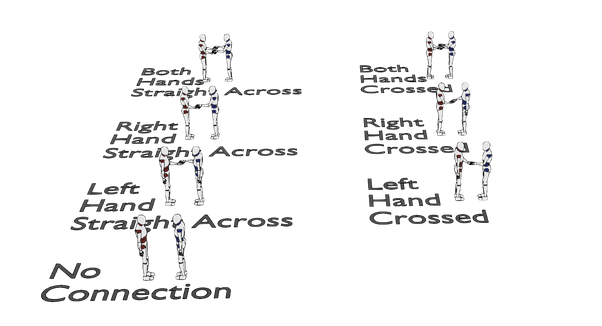
If you take the set of the leader's left hand, the leader's right hand, the follower's left hand, and the follower's right hand, and consider that a particular way of connecting through the hands is a partition of that set, then we know that there are 15 different ways to partition a set of 4 elements. This is called the Bell number for a set of a certain size and it counts the number of possible partitions of a set.
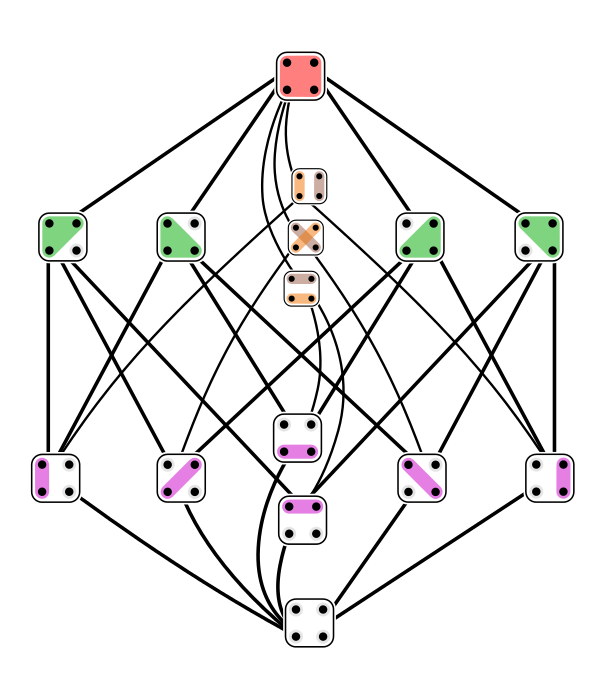
The diagram above shows the 15 partitions organized in a Hasse diagram, which illustrates the partial ordering of the partitions.
This number is definitive. All positions that involve two dancers can be described as falling into one of these 15 categories. From every possible position, if the dancers move, rotate and bend their bodies without ever changing the way their hands connect, they can always get back to one of these 15 original positions. Likewise, there is no amount of moving around, rotating, or bending that can turn one of these positions from one hand hold to another hand hold, provided that the hands are never let go of and no new connections are made.
The 15 different ways to connect through only the hands between two dancers are:
- No connection between their hands
- Lead's left hand straight across
- Lead's right hand straight across
- Both hands straight across
- Lead's left hand crossed over
- Lead's right hand crossed over
- Both hands crossed over
- Lead's left hand holding both of follower's hands
- Lead's right hand holding both of follower's hands
- Follower's left hand holding both of lead's hands
- Follower's right hand holding both of lead's hands
- Lead holding own hands
- Follower holding own hands
- Both holding own hands
- All holding all hands
The most common set of hand holds in social dancing are those that can be described by the complete bipartite graph K₂,₂, where each dancer's two hands connect to the other dancer's two hands. This includes positions 2, 3, 4, 5, 6, and 7—the fundamental connections that form the basis of most social dance patterns.
To learn more about the discovery and proof of this law, read our introductory blog post.